Project Overview
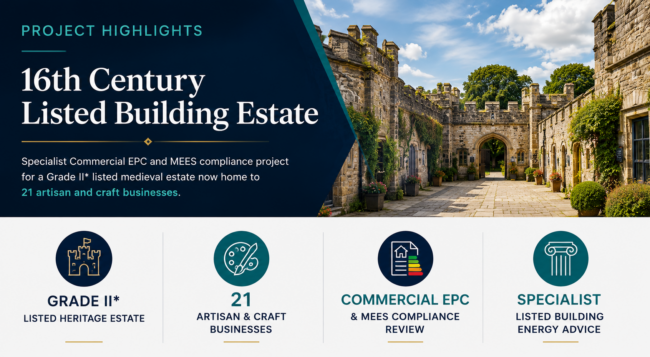
Brougham Hall is a remarkable Grade II* listed medieval estate with a history spanning centuries. Home to 21 artisan workshops, studios and craft businesses, the estate underwent a significant transition in 2024 when ownership and stewardship transferred from a charitable trust to a Community Interest Company formed by the tenant businesses themselves.
The new management team required specialist advice to understand their obligations regarding Commercial EPCs, Minimum Energy Efficiency Standards (MEES) and the unique considerations associated with listed and heritage properties.
The Challenge
There is a common misunderstanding that listed buildings are automatically exempt from the requirement to obtain an Energy Performance Certificate (EPC). In reality, listed properties and buildings located within conservation areas are not necessarily exempt, and property owners must understand whether an EPC is required for their specific circumstances.
Where a listed non-domestic property requires an EPC, it will also fall within the scope of the Minimum Energy Efficiency Standards (MEES) Regulations. Balancing compliance requirements with the protection of historic fabric and architectural significance presented a complex challenge for the estate.
The project involved assessing 21 occupied commercial units of varying ages, construction methods and uses, whilst carefully considering the limitations imposed by the building’s heritage status.
Our Approach
We undertook a comprehensive Commercial EPC and heritage compliance review across the estate. Detailed measured surveys were completed for each unit, including assessment of:
- Building use and occupancy
- Historic construction methods and materials
- Windows, doors and glazing specifications
- Heating and conditioning systems
- Lighting installations
- Energy performance characteristics
Our assessment process was entirely non-invasive, ensuring no damage or disruption to the historic fabric of the buildings.
Alongside the EPC assessments, we provided specialist guidance regarding listed building considerations, conservation requirements and potential pathways towards MEES compliance where improvements could be implemented without adversely affecting the character or appearance of the estate.
The Outcome
The project provided the Community Interest Company and its tenant businesses with a clear understanding of their Commercial EPC obligations, compliance position and future energy performance considerations.
Through detailed assessment and specialist reporting, the client gained the information needed to make informed decisions regarding energy performance improvements, future investment planning and compliance management, whilst preserving the historic character and significance of one of Cumbria’s most important heritage estates.
The result was a practical and balanced strategy that recognised both the regulatory requirements of modern commercial property management and the unique challenges associated with managing a Grade II* listed historic estate.